New FARAD Equipment
Define a new heat exchanger around the required duty, media, materials, connections, space and project documentation.
Choose this pathwayFARAD S.A. · PANAMA · VESSEL & PROJECT SUPPORT
FARAD marine heat exchangers with Panama-based technical definition, vessel attendance and replacement-project integration through TESS.
Send the FARAD model—or the details of the existing unit. TESS can define the equipment, replacement and vessel-side scope from Panama.
A nameplate photo, equipment photos and the vessel problem are enough to start. Availability and lead time are confirmed for the specific requirement.

START WITH THE COMMERCIAL REQUIREMENT
Choose the closest route. The first review can begin with limited information and identify what else is needed before manufacturer selection, quotation or onboard execution.
Define a new heat exchanger around the required duty, media, materials, connections, space and project documentation.
Choose this pathwayUse the model, serial number, nameplate, drawing or installed dimensions to review the correct renewal route.
Choose this pathwayEvaluate a FARAD engineered replacement for obsolete or other-manufacturer equipment after dimensional, thermal and system review.
Choose this pathwayRequest plates, gaskets or other identifiable components for existing FARAD equipment, subject to model and parts confirmation.
Choose this pathwayArrange vessel attendance in Panama to capture nameplates, measurements, connections, condition and access information.
Choose this pathwayEstablish whether the installed unit remains supportable and whether service, manufacturer reconditioning or replacement is the better path.
Choose this pathwaySend the vessel problem and the information you have. TESS can help define the correct technical and commercial pathway.
Choose this pathwayMANUFACTURER + PANAMA PROJECT INTERFACE
TESS works directly with FARAD S.A. to develop and support marine heat-exchanger equipment and project opportunities in Panama.
Customers can submit FARAD equipment, replacement, spare-parts and project requirements through TESS in Panama for technical and commercial review. TESS develops the vessel-side information, coordinates the manufacturer route and connects the selected equipment with the practical installation scope.
The relationship does not remove the need for project-specific engineering. Duty, dimensions, materials, connections, access, documentation and classification requirements are reviewed for the actual unit and vessel before a supply or replacement route is confirmed.
TIER A EQUIPMENT
The following product families cover the most common machinery, central-cooling and refrigeration replacement opportunities. Final selection remains specific to the thermal duty and vessel arrangement.
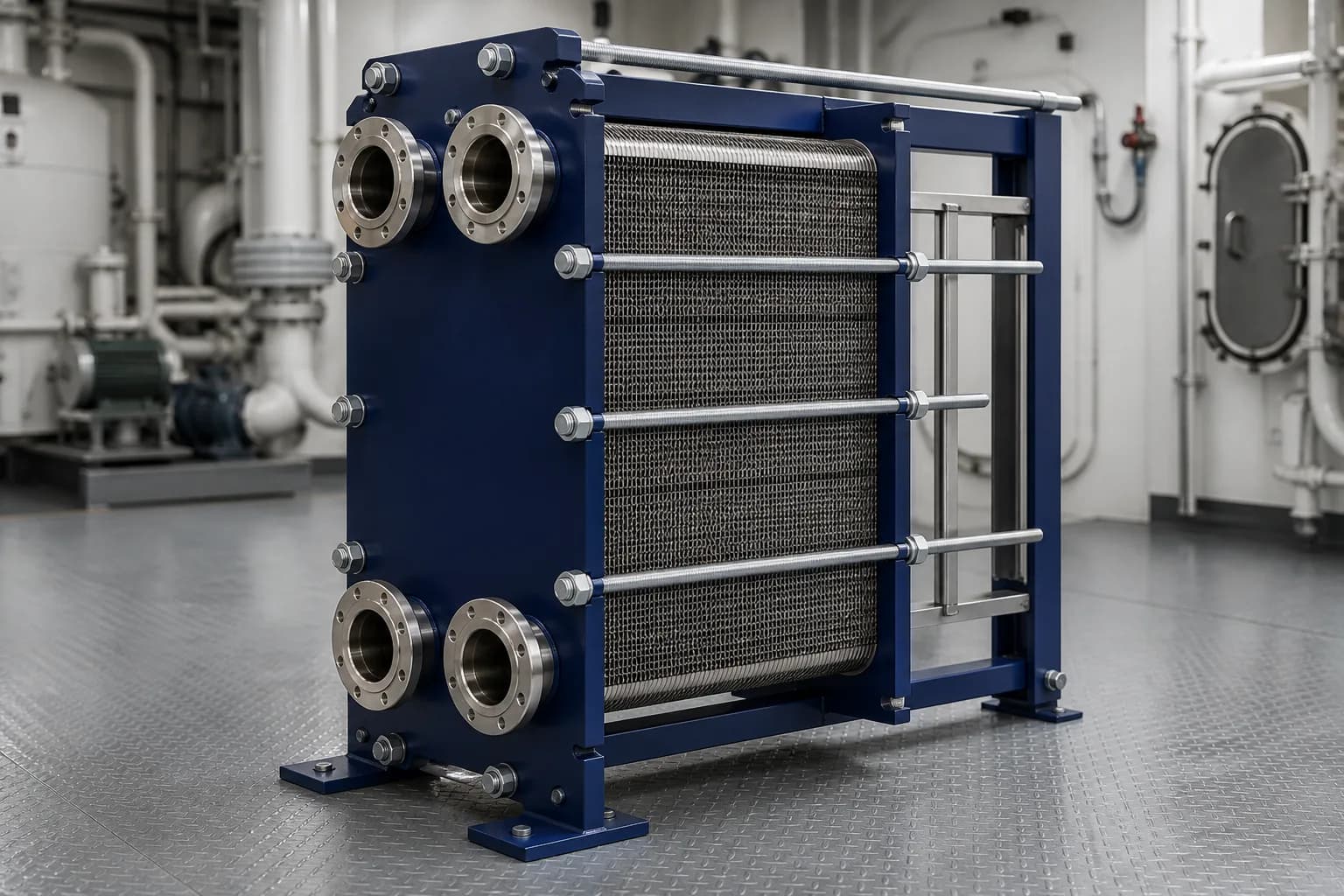
Compact plate units are widely applied in marine central-cooling, heating and cooling duties where a high transfer area must fit a controlled footprint. Plates and gaskets create a serviceable lifecycle, while connection orientation, plate material and gasket compound remain duty-specific.
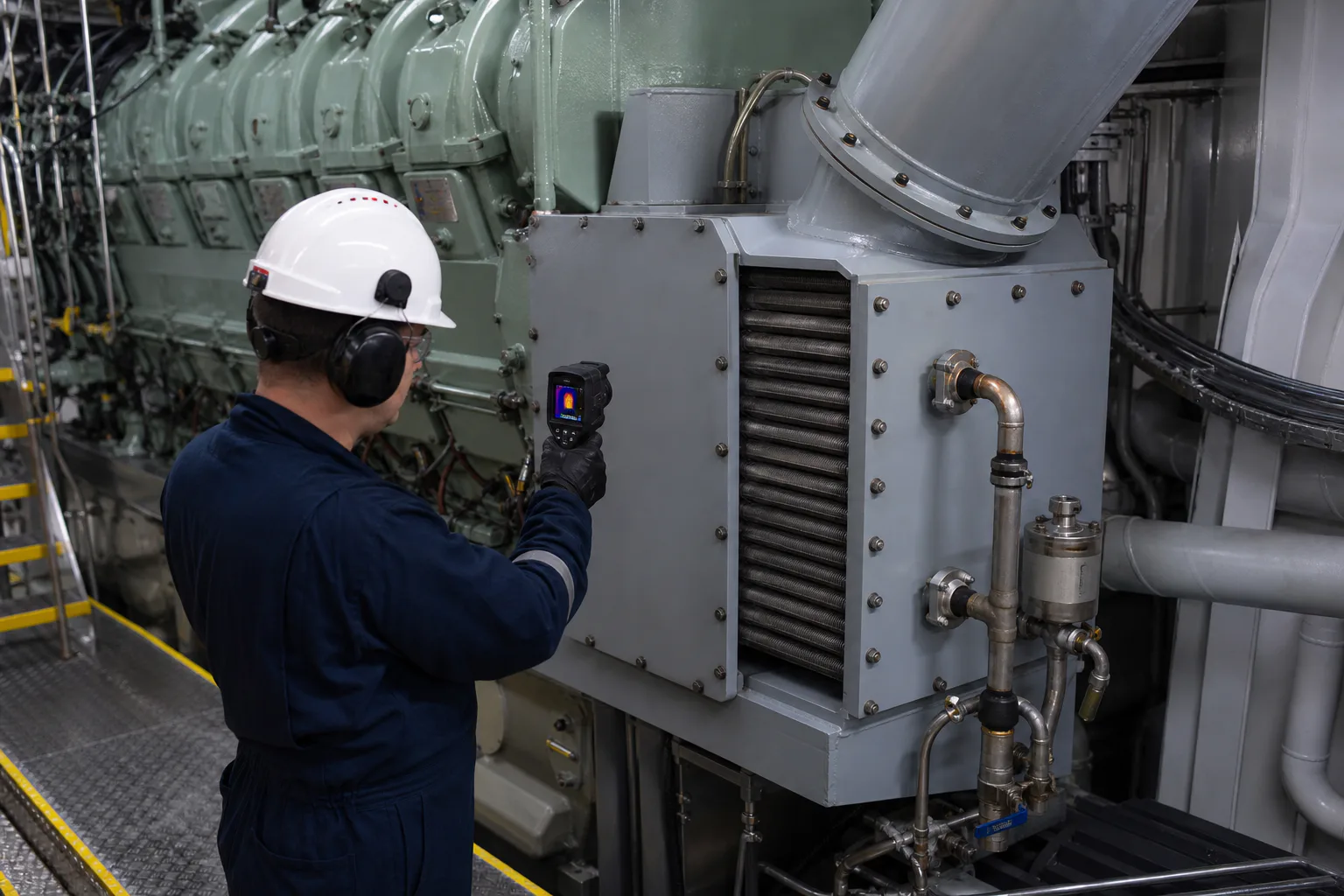
Charge-air coolers support main and auxiliary engine performance by controlling compressed-air temperature before combustion. Engine model, cooler arrangement, air-side geometry, cooling medium and access route matter as much as the external dimensions.
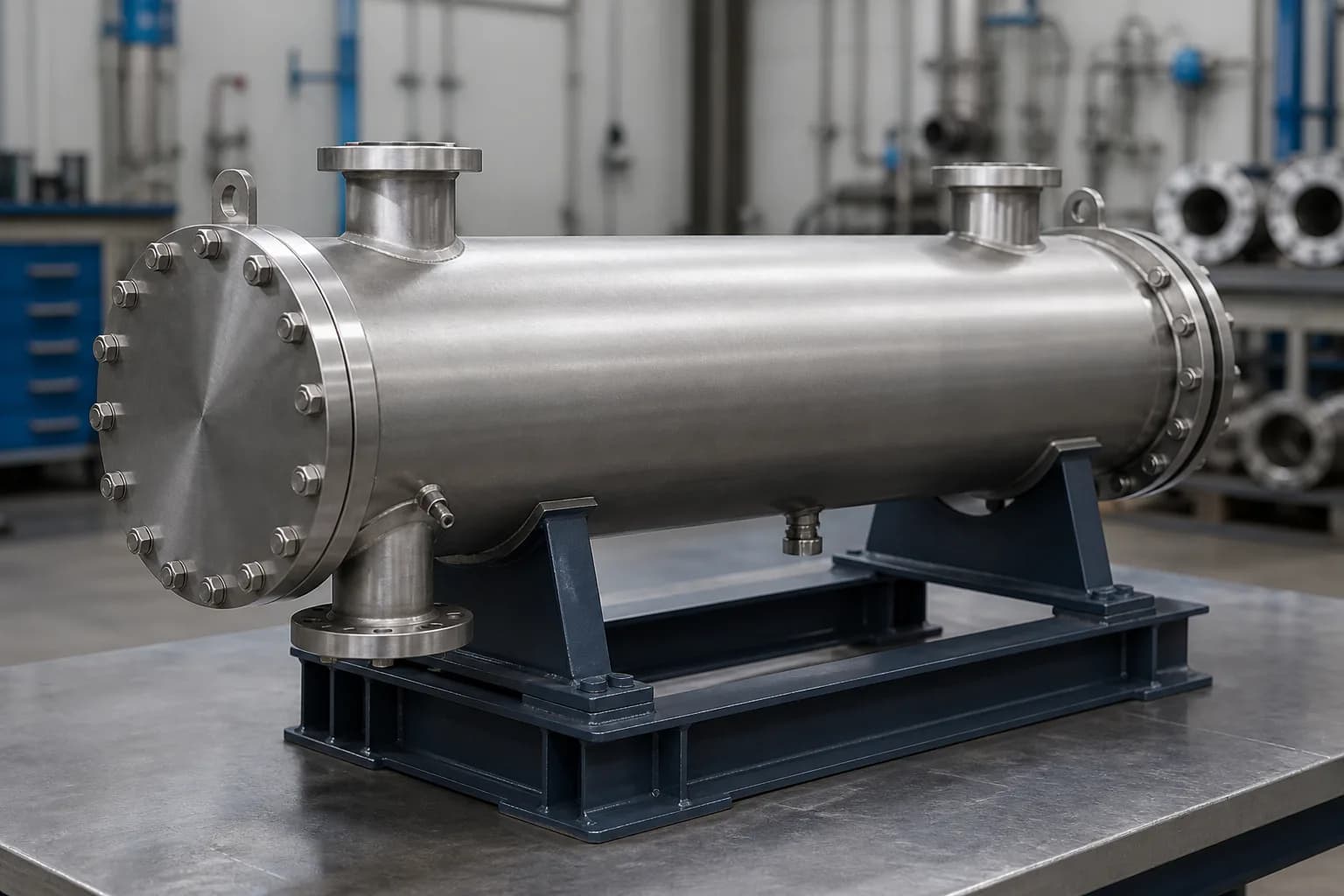
Tubular oil and water coolers serve lube-oil, hydraulic-oil, fresh-water, seawater and auxiliary cooling duties across machinery systems. Materials, velocity, pressure, temperature and fluid compatibility influence the correct construction.
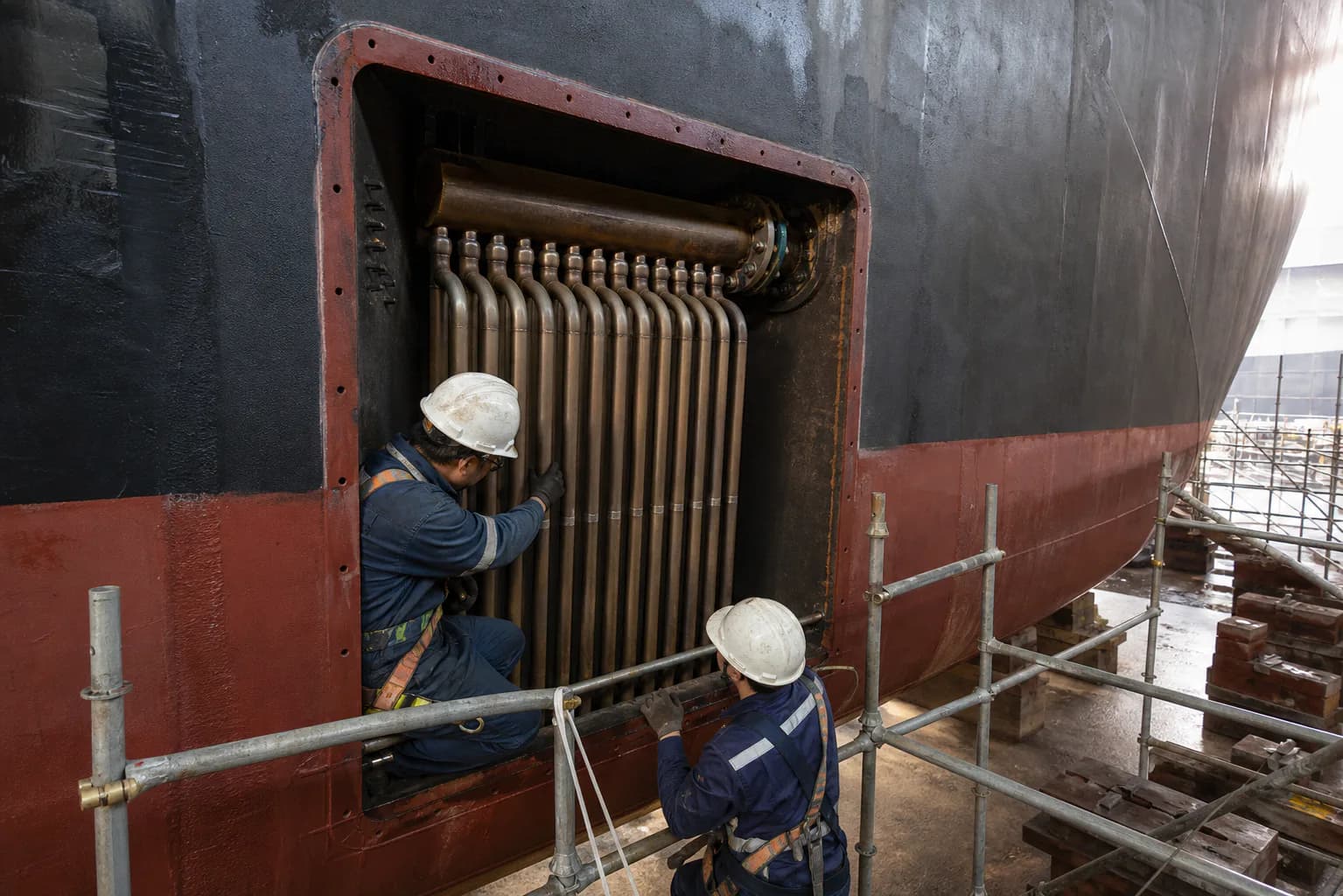
A box cooler rejects heat through a tube bank fitted within a vessel sea chest. The equipment cannot be separated from the hull, sea-chest, coating, piping and corrosion-control interfaces that make the complete project work.
FARAD condenser applications include FC condensers for marine refrigeration and HVAC duties, together with specialist cargo and COPT condenser requirements. The primary route on this page is equipment definition and replacement—not generic refrigeration troubleshooting.
SPECIALIST RANGE
FARAD's marine and industrial range extends beyond the priority products. These applications are grouped so the page remains useful without becoming a catalogue copy.
Requirements may include compressor coolers, MGO coolers or cooling units, HVAC air coolers, DX evaporators, heaters and related tubular or plate equipment. Selection is defined around the actual medium, duty and installation interfaces.
Specialist scopes may include cargo condensers, COPT condensers, tank-cleaning heaters, LNG/LPG vaporizers and relevant steam or process equipment. These are evaluated as project-specific duties rather than treated as standard stock products.
For chiller, AHU, FCU, ventilation and control diagnostics, use Marine HVAC Service.
INSTALLED FARAD EQUIPMENT
An existing FARAD model, serial number, drawing or nameplate creates the fastest manufacturer route. Send the identification together with the vessel, present condition, required outcome and service window.
FARAD's manufacturer service programme includes cleaning, repair or reconditioning, spare parts, optimisation, testing, shipboard services and passivation where relevant. The applicable service location and execution route are confirmed for the specific unit; these services are not presented as automatically available locally in Panama.
TESS can inspect the vessel-side condition, document the installed arrangement and coordinate the technical/commercial review. FARAD retains the manufacturer-side role for agreed factory or specialist services, while TESS manages the Panama, logistics and onboard integration scope included in the project.
OTHER BRAND · OBSOLETE UNIT · CHANGED DUTY
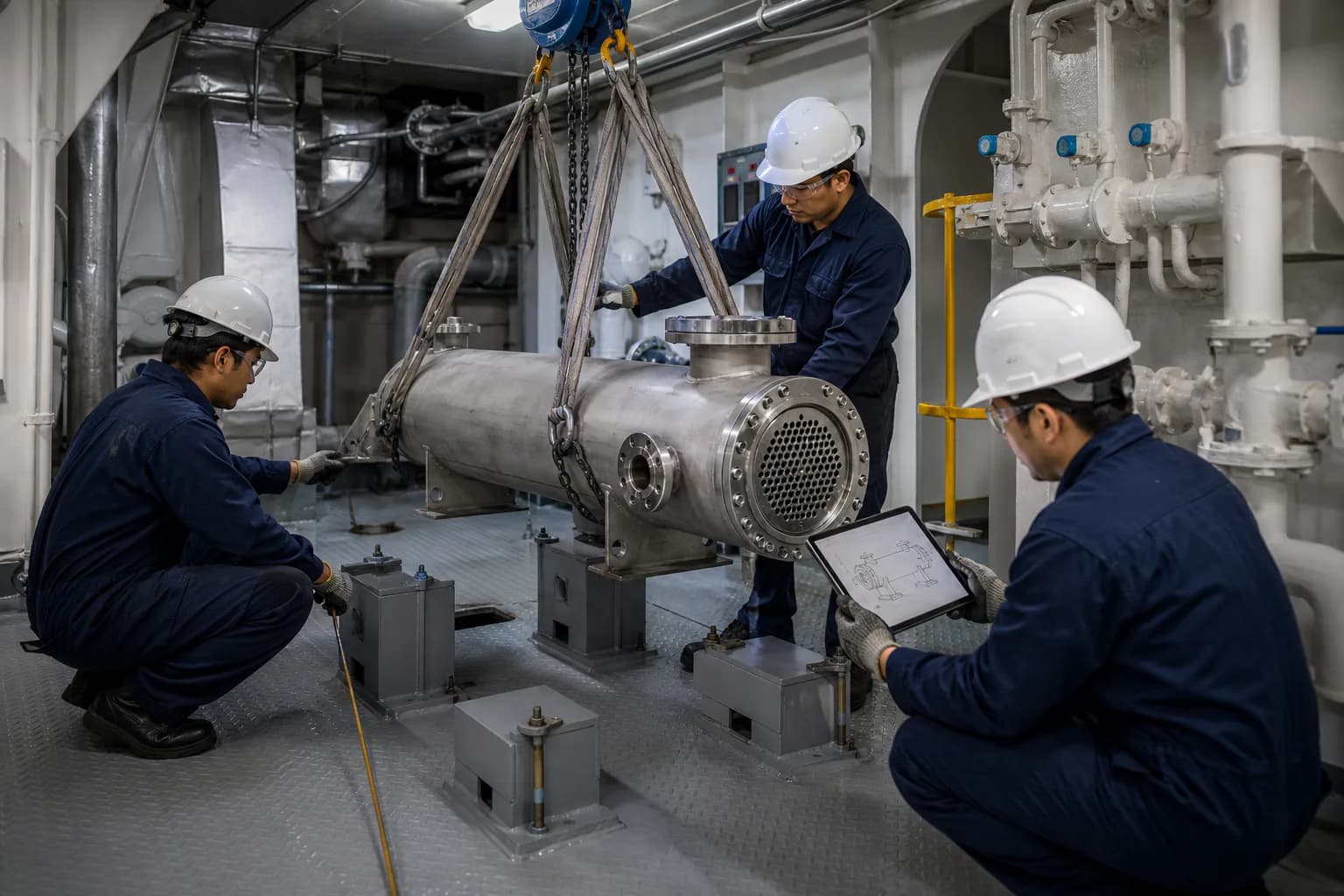
FARAD engineered replacement can be evaluated for existing FARAD or other-manufacturer equipment, subject to technical, dimensional, thermal-duty, material, connection and classification review.
A nameplate is a practical starting point, but the replacement decision is built from the complete requirement. Drawings, installed dimensions, nozzle positions, media, flows, temperatures, pressures, pressure-drop limits, material compatibility and service access help establish the correct technical basis.
The review also considers the vessel-side consequences. A new unit may require piping offsets, valve changes, foundations, supports, lifting arrangements, instrumentation, insulation or revised maintenance clearances. Those interfaces must be visible before the project is described as equivalent or ready to install.
Classification and certification requirements are defined for the specific unit and project at quotation and design stage. FARAD product documentation provides for third-party or classification-society approval according to product and project requirements; no universal approval is implied.
Request Engineered Replacement AssessmentEngineering & superintendence for technical definition and control →
KEEP THE RIGHT SEARCH AND TECHNICAL PATH
The right choice depends on remaining integrity, recoverable performance, parts support, lifecycle risk and the vessel's available window—not on brand preference alone.
For cleaning, leakage, fouling, pressure testing and multi-brand reconditioning, use TESS's dedicated marine heat exchanger repair and reconditioning service.
LOW-FRICTION TECHNICAL INTAKE
Send what you have. Full thermodynamic data is helpful when available, but it is not required for the first contact.
PACIFIC + ATLANTIC VESSEL SUPPORT
TESS operates from Panama City and can plan technical attendance around Balboa and Pacific-side calls, Colón or Cristóbal on the Atlantic side, anchorage, shipyard and dry-dock periods where access and scope permit.
Pre-arrival review can identify missing data, decide whether an onboard survey is needed and prepare manufacturer questions before the vessel reaches Panama. Once commercial terms and equipment availability are confirmed, TESS can coordinate delivery and the practical vessel interface.
TESS develops FARAD marine heat-exchanger opportunities from Panama and can evaluate regional vessel or project support where scope and logistics justify mobilization. This describes TESS operational reach, not a formal FARAD representation territory.
USE THE PANAMA CALL INTELLIGENTLY
Inspection, identification, measurements, photographs, data capture, condition review, scope definition and delivery of confirmed equipment or spares.
Smaller exchanger, PHE, charge-air, oil/water or condenser replacement; limited piping changes, lifting, leak testing and commissioning.
Large central-cooling changes, major rerouting, difficult access or lifting, several connected replacements and wider retrofit work.
Box-cooler replacement, sea-chest or hull interfaces, coating restoration and work that requires the vessel out of the water.
Not every heat-exchanger replacement can be completed within a single Panama Canal call. Scope depends on access, isolation, lifting, piping interfaces, equipment availability and the vessel's confirmed repair window.
BEYOND EQUIPMENT SUPPLY
A technically correct exchanger still has to become a functioning part of the vessel. TESS connects manufacturer-defined equipment with the onboard work required to remove the old unit, install the new one and verify the agreed result.
FARAD remains responsible for agreed manufacturer-side design, review and specialist services. TESS defines and executes or coordinates the Panama/vessel-side scope included in the confirmed project.
COMMERCIAL VESSEL APPLICATIONS
Primary requirements commonly arise on containerships, bulk carriers, tankers and product/chemical tankers, reefer vessels, fishing or factory-fishing vessels and selected gas carriers.
Relevant project opportunities may also arise on passenger vessels, ferries, tugs and workboats, dredgers, offshore or support vessels, research vessels and large yachts or superyachts.
MANUFACTURER EVIDENCE
A Greek manufacturer with established marine and industrial heat-exchanger activity since 1979.
Both tubular heat exchangers and gasketed plate heat exchangers across relevant marine duties.
Made-to-order equipment can be developed around project-specific duty and installation requirements.
Replacement pathways can be evaluated for FARAD, obsolete and other-manufacturer equipment after technical review.
Manufacturer service, reconditioning and spare-parts routes support existing FARAD equipment where applicable.
Third-party or class-related documentation can be defined according to the product and project requirement.
WHY NOT CONTACT THE FACTORY WITH AN UNDEFINED REQUEST?
A manufacturer can evaluate equipment more effectively when the vessel requirement is technically clear. TESS closes the gap between an onboard problem and a manufacturer-ready RFQ, then connects the equipment with local execution.
The value is not simply forwarding a part number. It is turning the vessel's equipment requirement into a reviewable FARAD pathway and an executable onboard project.
SPECIALIST FARAD RFQ
Provide the known vessel, schedule and equipment information. The form accepts a minimum-data chief-engineer enquiry, a purchasing request with model or part details, and an other-brand engineered-replacement assessment.
Send what you have. Nameplates, equipment photos, drawings, datasheets, dimensional sketches, P&ID, manuals and previous reports are useful where available.
COMMERCIAL & TECHNICAL QUESTIONS
Customers can submit FARAD equipment, replacement, spare-parts and project requirements through TESS in Panama for technical and commercial review. Supply, availability and lead time are confirmed for the specific requirement.
Customers can submit FARAD equipment, replacement, spare-parts and project requirements through TESS in Panama for technical and commercial review.
Yes. FARAD engineered replacement can be evaluated for other-manufacturer or obsolete equipment, subject to duty, dimensions, materials, connections, classification and installation review.
Yes. A clear nameplate photo, equipment photos, vessel, location and problem are enough to start. Drawings, dimensions and operating data can follow where available.
Priority applications include gasketed plate heat exchangers, charge-air coolers, oil and water coolers, box coolers and marine condensers, with additional specialist tubular and plate equipment.
Yes. FARAD manufactures tubular and gasketed plate heat exchangers, including relevant marine charge-air, oil and water cooler applications.
FARAD manufactures box coolers. Replacement commonly involves sea-chest, hull, coating and piping interfaces and is therefore likely to require a planned dry-dock scope.
Yes. Existing FARAD model, serial and parts information can be submitted through TESS. Applicable spare-parts, manufacturer service or reconditioning routes are confirmed for the specific unit.
Some inspections, deliveries and smaller replacement scopes may fit a confirmed call. Large rerouting, difficult lifting, central-cooling changes and box-cooler work require a planned repair or docking window.
Yes. TESS can evaluate Panama attendance to capture identification, dimensions, nozzle positions, access, surrounding piping, supports and the information needed for manufacturer review.
Repair may suit a structurally viable and supportable unit; replacement may be better where obsolescence, recurring failure, severe damage, poor parts support or a changed duty makes renewal more credible.
Project documentation and third-party or classification-society approval requirements are defined for the specific product and project during quotation and design. No universal approval claim is made.
FROM NAMEPLATE TO EXECUTION PLAN
Send the vessel, current location, model or nameplate, equipment photos and the required outcome. TESS will review the available information and define the next technical and commercial step with FARAD where appropriate.