Refrigeration Equipment
Compressors, condensers, evaporators, refrigerant circuit, airflow, defrost, sensors and controls must create and distribute sufficient cooling for the actual cargo duty.
REEFER VESSELS · FISHING FLEET · FREEZER VESSELS · FISH CARRIERS · PANAMA
TESS surveys, troubleshoots, repairs and renews refrigerated cargo-hold thermal envelopes—connecting insulation condition, moisture, thermal bridges, lining, doors and structural interfaces with the refrigeration duty of working reefer and fishing fleets.
Start with condition and heat-load evidence. Repair locally where the surrounding envelope remains sound; renew partially or reconstruct the complete hold where condition and lifecycle justify it.

PLANT · ENVELOPE · BOTH
A compressor plant can run, evaporators can produce cooling and controls can remain active while heat continues entering through the cargo-space boundary. The operating symptom may look like insufficient refrigeration capacity even when part of the load is being created by degraded insulation, failed lining joints, door leakage or conductive structural paths.
The opposite is also possible: a sound thermal envelope cannot compensate for weak refrigeration capacity, poor airflow, ineffective defrost, control faults or degraded heat rejection. TESS therefore treats a hold-temperature complaint as a system diagnosis—not as automatic proof that either insulation or refrigeration equipment has failed.
Compressors, condensers, evaporators, refrigerant circuit, airflow, defrost, sensors and controls must create and distribute sufficient cooling for the actual cargo duty.
Insulation, lining, structure, doors, hatches, floors, penetrations and drainage must limit heat and moisture paths around the complete refrigerated boundary.
An aging envelope can increase load on an already marginal plant. Measuring both sides prevents an equipment-only repair from leaving the owner with the same temperature problem.
ONE CARGO-SPACE SYSTEM
Performance depends on continuity across every surface and interface. A visually sound wall panel does not prove that the structure behind it, the deckhead, the floor or the openings are performing correctly.
For the complete vessel thermal-system architecture, review Marine HVAC & Refrigeration.
WORKING VESSEL MARKETS
The construction details and operating priorities change by vessel, cargo and duty. The survey and retrofit route must reflect the working cycle—not only the nominal hold temperature.
Conventional refrigerated cargo carriers can have extensive multi-hold boundaries, large surface areas and aging systems exposed to repeated loading cycles. Temperature stability, airflow and envelope continuity must be evaluated across the cargo arrangement.
Trawlers, purse seiners, tuna vessels and longliners combine hard operating cycles with wet service, wash-down, hygienic lining, machinery-space heat and frequent mechanical impact around fish holds.
Low-temperature duty and long processing or storage cycles make thermal-envelope reliability, door discipline and refrigeration load especially important. Small discontinuities can become persistent operational loads.
Loading and unloading activity can damage liners, thresholds, doors and drainage interfaces. The repair must protect cargo preservation while remaining practical for the vessel's handling pattern.
Multipurpose, research, passenger and other vessels may contain large temperature-controlled cargo or store spaces that justify a vessel-specific envelope scope. Yacht provision rooms remain primarily within Marine Refrigeration.
PROBLEM-BASED INSPECTION
No single symptom proves insulation failure. Patterns, operating data and physical condition together indicate where the next inspection should focus.
WHY PERFORMANCE CHANGES
A thermal envelope usually deteriorates through accumulated interfaces and vessel history rather than one dramatic event. Loading damage may break the lining; moisture can then reach the insulation; later steel work or added penetrations can interrupt continuity again.
WET ENVELOPE RISK
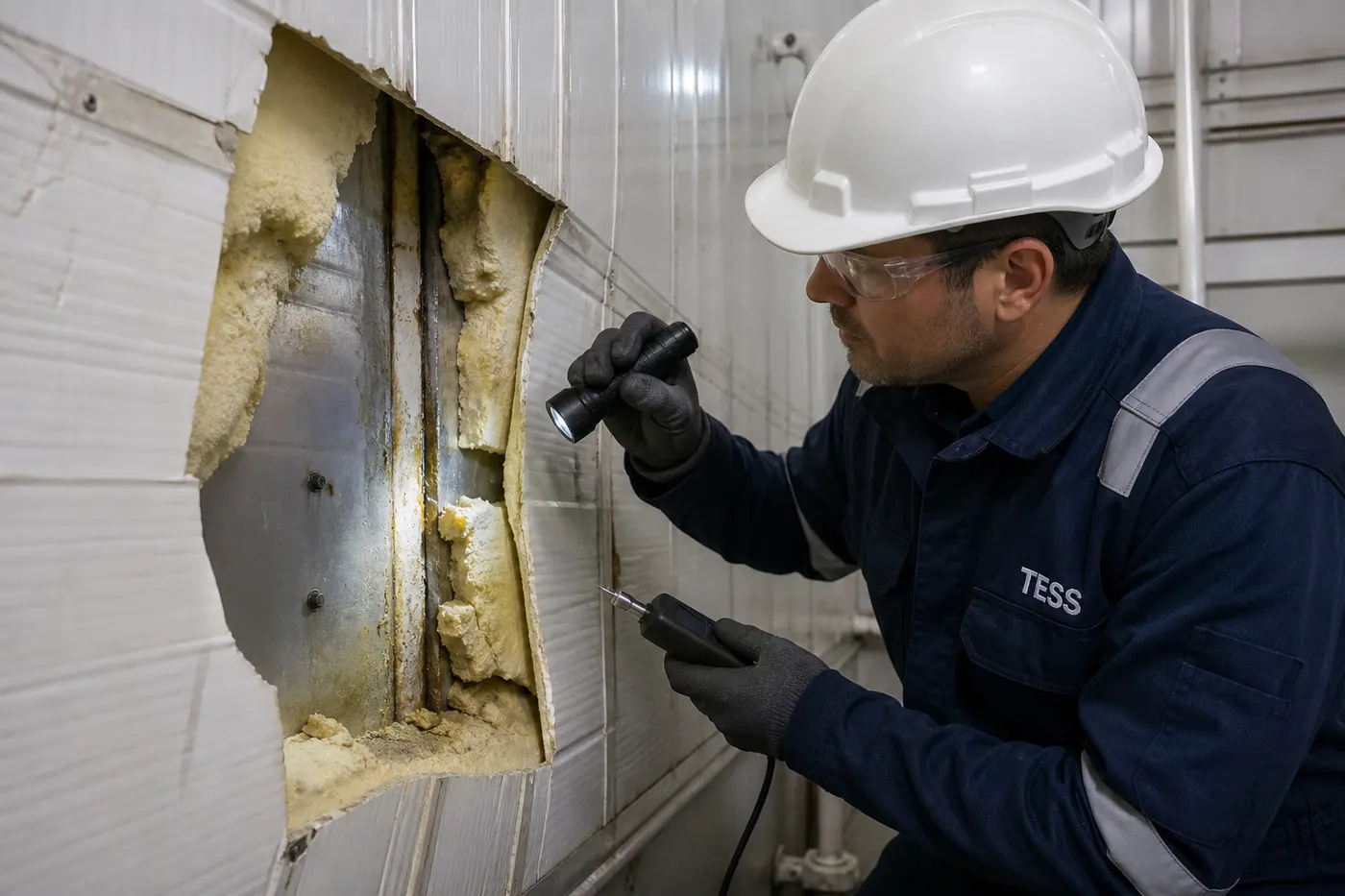
Water or vapour entering the build-up can reduce thermal performance depending on the insulation system, increase local heat transfer and keep the cold-side interface persistently wet. The visible symptom inside the hold may be remote from the entry path.
Moisture can also attack coatings and concealed steel, degrade lining supports and enlarge what first appeared to be a small panel repair. Condition cannot always be established visually from the cargo side, and indiscriminate removal can create more work without improving the diagnosis.
Where appropriate, TESS can combine visual survey, thermal observations, moisture investigation and agreed targeted openings to document affected zones. Thermography is useful only when operating conditions and temperature differences make the observation meaningful; it does not determine insulation condition by itself.
CONDUCTIVE HEAT PATHS
A thermal bridge is not simply an area with thin insulation. Conductive structural continuity can carry heat through or around the insulated plane. Frames, stiffeners, deck supports, hatch coamings, floors, bulkhead junctions and penetrations can become repeat warm paths even when adjacent insulation remains intact.
Machinery-space bulkheads and exposed working decks deserve particular attention because the boundary conditions can be more severe. Locally adding insulation without understanding how the steel member connects across the envelope may shift the symptom rather than solve it.
The retrofit detail must maintain practical structural access, lining support and cargo-space durability while reducing the unintended heat path. The final arrangement is defined for the vessel, construction and applicable review—not from a generic detail copied between holds.
THE PROTECTIVE INNER BOUNDARY
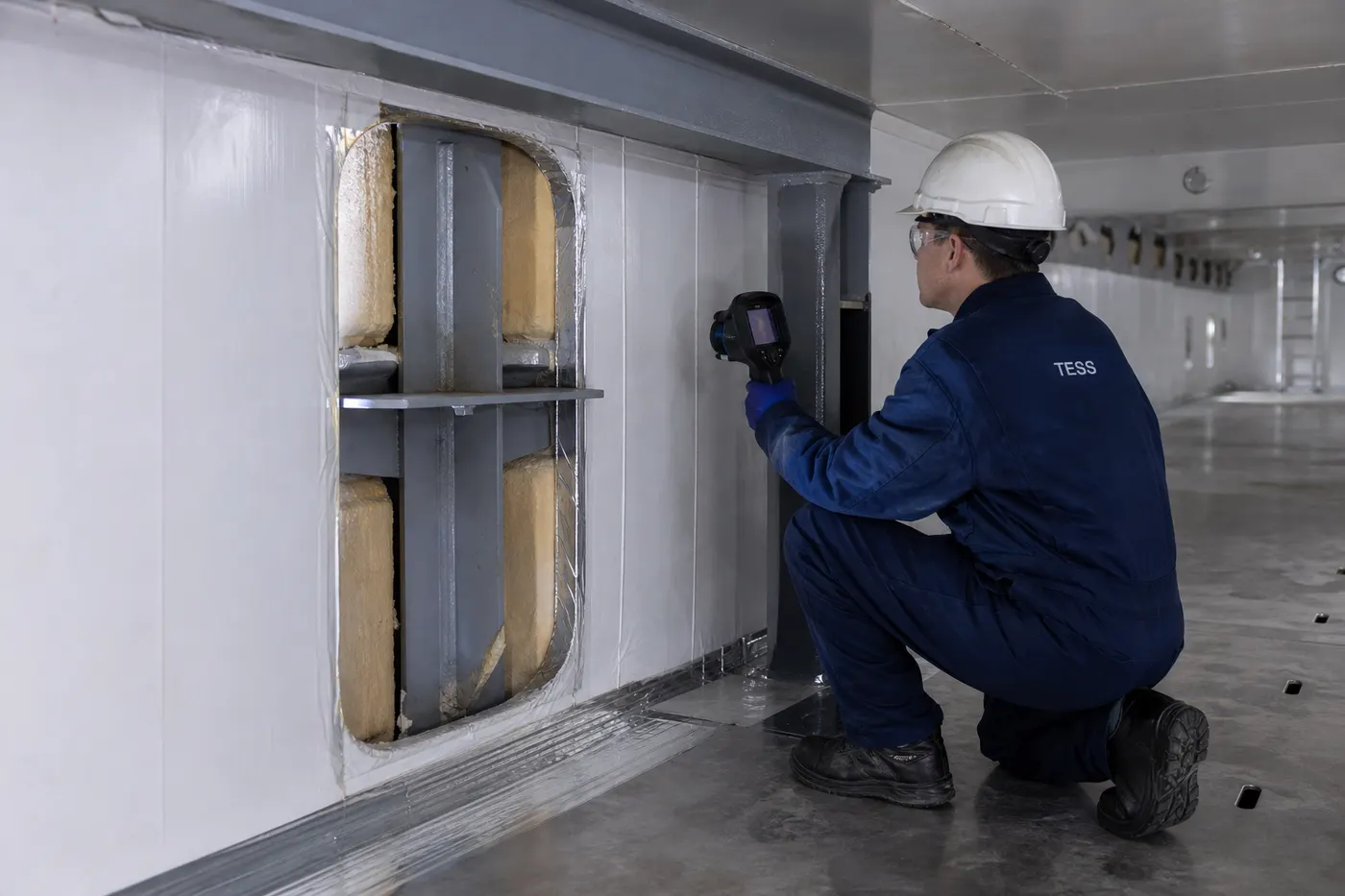
The lining protects insulation from cargo impact, wash-down, moisture and routine access. Its joints, fasteners, supports and transitions influence whether the envelope remains sealed and maintainable. In fish service, cleanability and hygiene add another demanding operating requirement.
A durable repair must address the substrate and joint detail, not just cover a damaged face. Marine metallic lining, stainless arrangements, GRP or composite systems may be appropriate depending on cargo, mechanical duty, fire and approval requirements, access and lifecycle. TESS does not prescribe one universal lining material.
LOCAL HEAT-LEAK PATHS
A complete wall renewal cannot correct a failed insulated door, compressed seal, damaged threshold or untreated penetration. Openings concentrate movement, maintenance and cargo-handling damage, so their interfaces need explicit survey and detailing.
Drainage and defrost water must also be considered. A drain that crosses the envelope or a low point that retains water can create a thermal, moisture and maintenance issue at the same location.
INSPECT BEFORE STRIPPING
The objective is to define the problem boundary before committing the owner to unnecessary removal. Available drawings and operating history are compared with the current physical condition and refrigeration duty.
Cargo, target temperatures, arrangement, drawings, original specification, refrigeration capacity, symptoms, service history and previous repairs.
Lining, doors, deckhead, floors, drainage, penetrations, structural interfaces and accessible insulation condition.
Temperature observations, meaningful thermal imaging, moisture indications, damage zones and repeat interface patterns.
Compare physical findings with plant data, airflow, controls, operating cycle and any approved targeted openings.
Separate localized repair candidates, partial-renewal zones, wider retrofit needs and refrigeration or structural follow-up.
Thermography alone does not determine insulation condition. Access, operating state, ambient conditions, cargo condition and surface emissivity all affect interpretation.
PAID TECHNICAL SCOPE
A structured thermal-envelope and condition assessment gives the superintendent a defensible basis for engineering, budgeting and selecting the execution window. The deliverable is matched to access and the agreed survey scope.
RIGHT-SIZED INTERVENTION
Condition, extent, compatibility, access and lifecycle—not a preset sales route—determine the intervention. Local damage does not automatically justify stripping the whole hold, while repeated patching is poor value when the surrounding system is widely compromised.
Suitable where the damaged zone is defined and adjacent insulation, lining and structure remain serviceable.
Suitable where one wall, deckhead, floor, compartment or repeat interface has degraded beyond a durable local repair.
Considered where moisture or degradation is extensive, interfaces have failed widely, duty changed or repeated repairs no longer support lifecycle objectives.
FROM EXISTING CONDITION TO HANDOVER
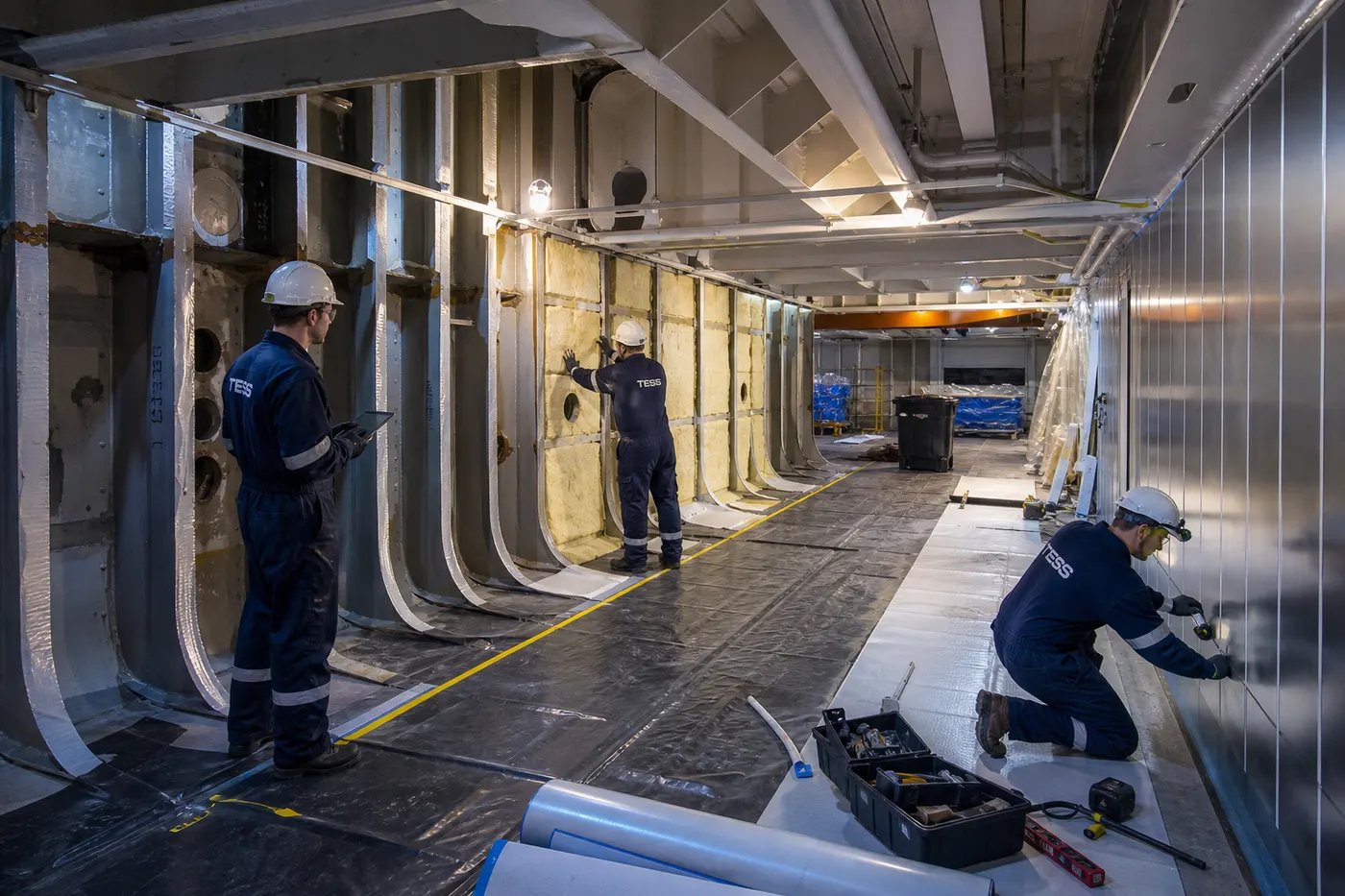
A complete retrofit is a planned marine construction project. Sequencing protects the vessel, allows concealed steel to be assessed and keeps insulation, lining, refrigeration and verification under one technical route.
FISHING & FREEZER FLEET
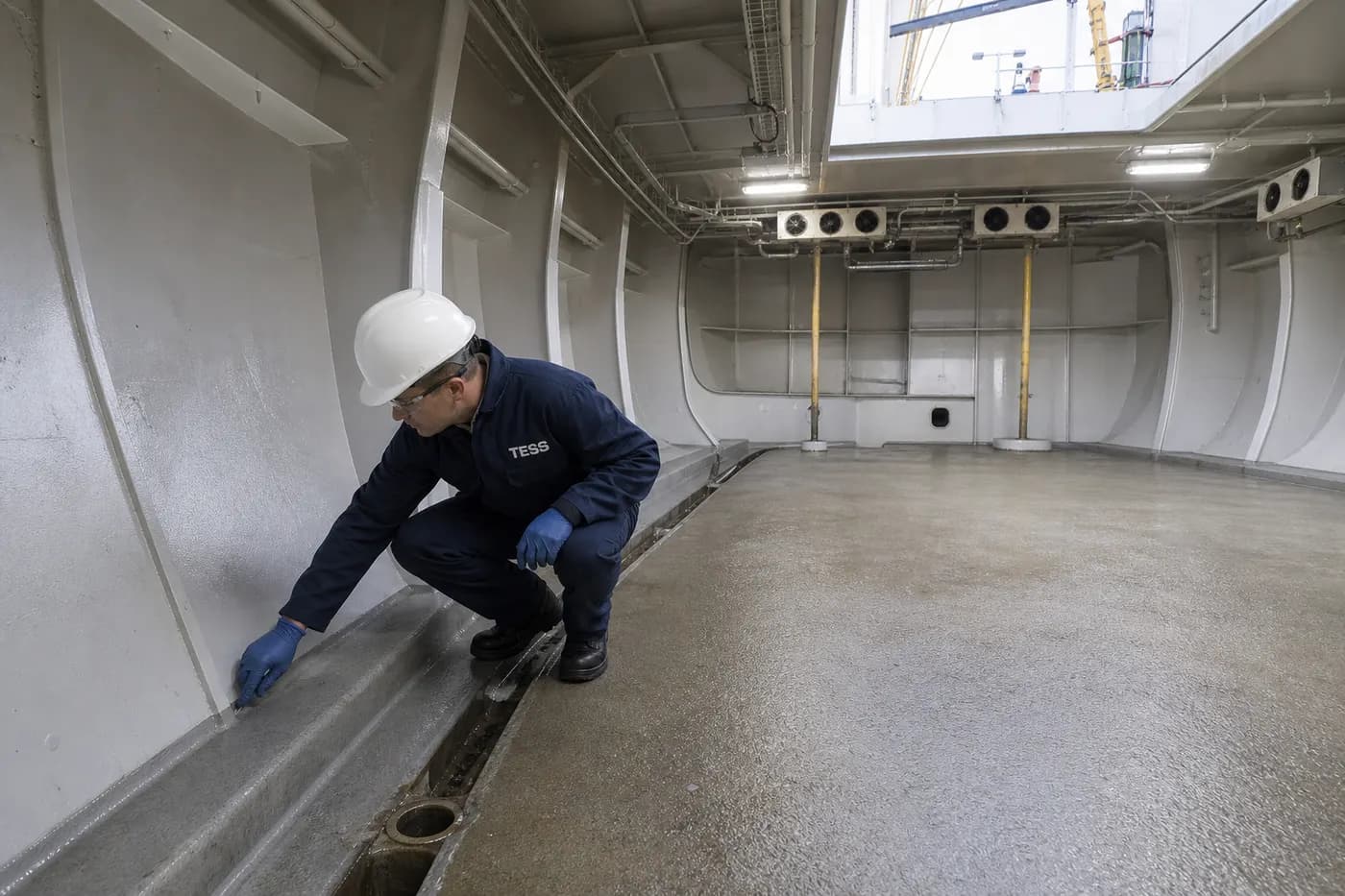
Fish-hold insulation works in one of the vessel's hardest environments. Trawlers, tuna vessels, longliners, purse seiners, freezer vessels, factory vessels and fish carriers combine wet service, wash-down, cargo impact, drainage, hygiene and long working cycles with heat from machinery spaces and exposed decks.
The scope must start from how product is handled and cooled. A chilled fish hold, frozen-product store, blast-freezing interface, RSW/CSW arrangement or factory-vessel space can impose different temperature, moisture, lining and drainage demands. The envelope and refrigeration route must match that duty.
Engine-room bulkheads, working decks, hatch coamings, floors, penetrations and loading-impact zones deserve explicit review. Adding insulation also reduces clear cargo volume, so the owner needs a practical balance between thermal performance, usable capacity, hygiene, durability and access.
VESSEL-SPECIFIC SYSTEM SELECTION
Potential arrangements may involve closed-cell rigid foam, board or panel systems, sprayed systems, composite constructions, protective coatings, marine lining and approved insulated doors. Naming a material family does not define the finished system: substrate preparation, continuity, joints, supports, moisture protection, lining and interfaces control whether the arrangement performs in service.
Selection depends on required temperature, climate, steel configuration, thermal duty, cargo, mechanical exposure, cleaning regime, available thickness, access, cargo-volume impact, lifecycle, project budget and the applicable approval route.
Material selection, insulation arrangement, lining system and structural interfaces must follow the vessel-specific project specification and applicable Class / Flag requirements. TESS does not claim that one system, foam chemistry, thickness, U-value or density is universally acceptable.
MEASURE BOTH SIDES
A degraded envelope increases heat load, compressor running time and demand on evaporators, condensers and controls. A weak refrigeration plant, restricted airflow or poor heat rejection cannot be corrected by adding insulation. The measured operating problem determines where the engineering effort belongs.
TESS can review cargo-space temperatures, target duty, plant loading, evaporator and airflow condition, condenser performance, defrost, controls and available capacity alongside envelope condition. Refrigeration-plant ownership remains with the dedicated Marine Refrigeration Repair service; this page owns insulation, lining, moisture, doors, structural thermal bridges and hold reconstruction.
Review Marine Refrigeration RepairWhen heat-rejection findings involve condensers or coolers as heat-transfer equipment, also review Marine Heat Exchanger Repair.
PLANT RUNNING · HOLD STILL WARM
Send TESS photographs of the hold, lining, doors and affected interfaces together with available temperature records. We can help define whether the next step should focus on the refrigeration plant, the thermal envelope or both.
OWNER-LEVEL DESIGN DECISION
More thickness is not automatically the best solution. A retrofit can affect internal volume, pallet geometry, loading clearances, doors, floor arrangement, access, refrigeration distribution and the vessel's commercial earning space.
The selected arrangement must deliver the required duty without creating an impractical hold or hiding future inspection and maintenance needs.
PROJECT-SPECIFIC ACCEPTANCE
Verification confirms workmanship, continuity and system operation against the project specification. Acceptance values and operating conditions are defined for the vessel and scope; TESS does not publish a false universal pass/fail value.
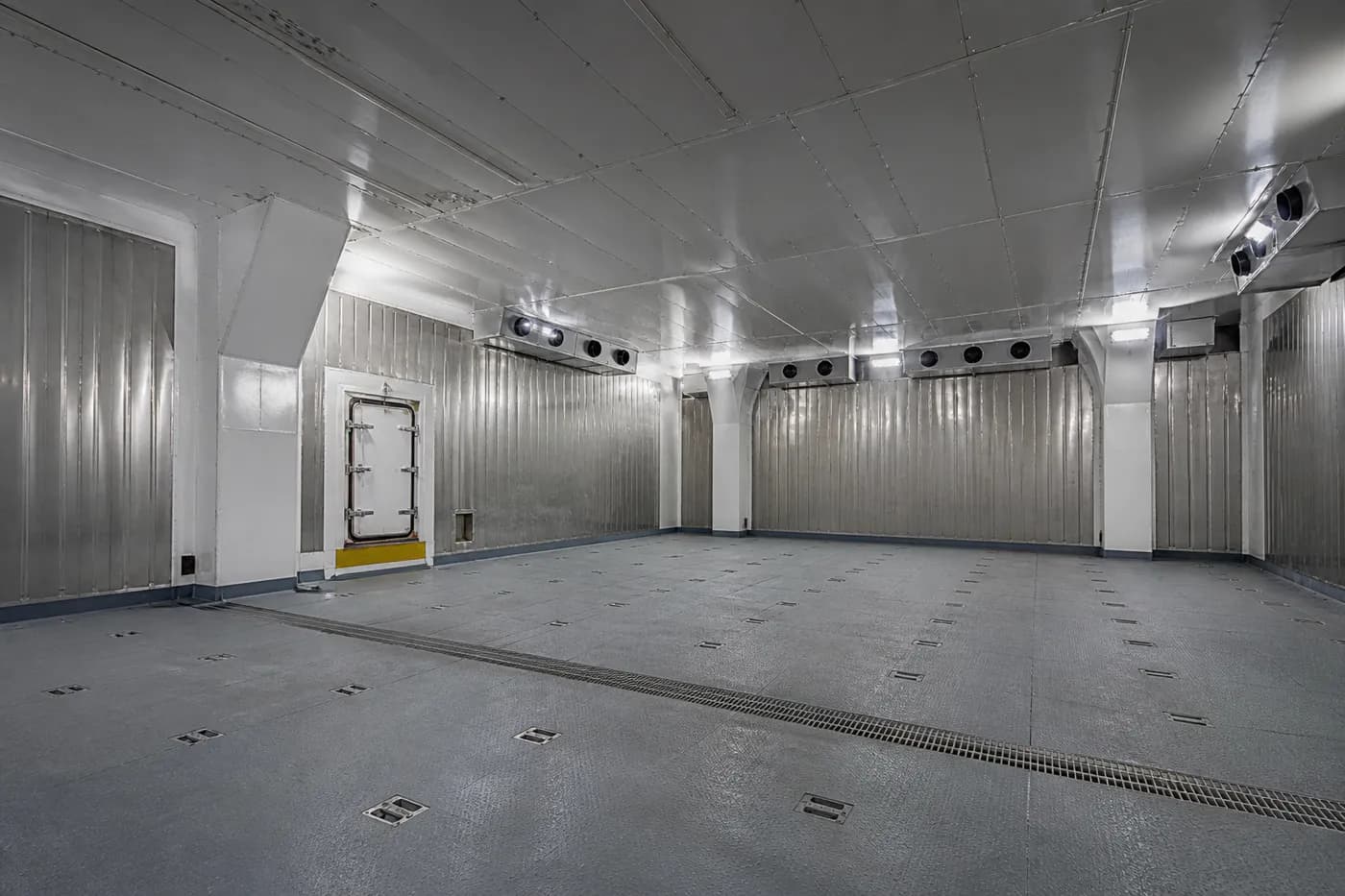
ENGINEERING + LOGISTICS + EXECUTION
TESS uses Panama as a technical, logistics and execution hub—not simply a location keyword. Survey and planned attendance can be coordinated around Balboa and the Pacific side, Cristóbal and Colón on the Atlantic side, alongside, at a suitable shipyard or within a planned maintenance call.
Confirmed larger projects may justify regional mobilization when access, materials, engineering and commercial scope are defined. The execution plan follows the actual hold condition and vessel programme.
DEFINE THE PROJECT DURING TRANSIT
A short Panama call may not be long enough to execute a complete hold retrofit, but it can be valuable for collecting the evidence required to plan one. Early inspection reduces uncertainty before the next shipyard, dry-dock or operational maintenance window.
Subject to access, vessel condition and agreement, TESS may inspect lining, doors, hatches, drains and structural interfaces; review temperature records; take measurements and photographs; verify drawings; perform meaningful thermal observations; and identify areas for later or approved targeted opening.
Localized inspection or limited repair may sometimes be practical. TESS does not promise a complete cargo-hold retrofit during a short Canal waiting period; full renewal requires a planned window for access, cleaning, removal, waste control, steel inspection, preparation, installation, curing where applicable, testing and survey attendance.
Use the call to inspect, document, measure and prepare the repair specification before the vessel's next planned maintenance window.
Plan a Panama Cargo Hold SurveyREALISTIC PROJECT WINDOWS
Dry dock is not automatically required. Access, waste handling, structural findings, coating work and external boundary interfaces determine where the work should be performed.
Suitable internal cargo-space work may be completed afloat when the hold is empty, access and environmental controls are adequate, and no dock-dependent structural or shell work is required.
Heavy removal, fabrication, waste management, coating, structural repair, material staging and major logistics may justify a controlled shipyard execution window.
Docking is considered where shell work, external plating, major tank or boundary repairs, or another dock-dependent scope intersects the retrofit. It is not a default requirement.
CAPEX + OPERATIONS
Where the hold arrangement and cargo programme permit, renewal may be evaluated by compartment, hold, wall, deckhead zone or planned maintenance period. Phasing can prioritize the worst-performing boundary, spread capital expenditure and avoid stripping serviceable areas.
A phased route must preserve continuity at each temporary or permanent boundary and must not compromise hygiene, cargo operations or verification. It is an option to engineer—not a promise for every vessel.
WHEN THE SCOPE EXPANDS
Opening the envelope can reveal work beyond insulation. TESS can integrate the interfaces under a broader repair, refit, dry-dock or engineering scope rather than leaving the owner to coordinate disconnected contractors.
Integrated equipment, structure, electrical, controls, testing and handover.
Coordinate the hold retrofit within a wider vessel modernization programme.
Plan dock-dependent structural and boundary work with the vessel's full specification.
Develop scope, review proposals, supervise execution and close documentation.
Connect suitable internal repairs with Panama attendance and onboard execution.
PRE-SURVEY INFORMATION
Perfect documentation is not required. Start with the vessel, hold, problem and available window; drawings and records help TESS prepare a more useful survey.
SPECIALIST CARGO-HOLD RFQ
Use the specialist form to define the hold, symptoms, service route and Panama window. Photos, drawings and previous reports can be attached securely.
Required fields are marked *. Up to five validated attachments, 5 MB each and 10 MB total.
OWNER & SUPERINTENDENT QUESTIONS
Cooling may be produced while heat enters through degraded insulation, thermal bridges, lining joints, doors, hatches, floors or penetrations. Plant capacity, airflow and controls may also contribute, so the envelope and refrigeration performance should be evaluated together.
TESS reviews symptoms, temperature records, plant loading, airflow, controls and heat-rejection condition alongside lining, doors, structural interfaces, moisture indications and meaningful thermal observations. Findings determine whether the next scope belongs to the plant, envelope or both.
Moisture can reduce performance depending on the insulation system, increase local heat transfer and contribute to concealed coating or steel damage. The entry path and extent may require moisture investigation and agreed targeted access rather than visual inspection alone.
Thermal bridges are conductive paths through or around the insulated boundary, often associated with frames, stiffeners, supports, floors, coamings or penetrations. They are structural interface problems, not simply proof of thin insulation.
Yes, when survey evidence shows damage is localized and adjacent insulation, lining, structure and interfaces remain serviceable. Local repair is not recommended blindly when moisture or deterioration extends beyond the visible opening.
Complete retrofit may be justified where degradation or moisture is widespread, many interfaces have failed, the original system is obsolete, vessel duty changed or repeated local repairs no longer provide a sound lifecycle route. The decision follows assessment.
Yes. TESS can assess fish-hold insulation, hygienic lining, drainage, doors, working-deck and machinery-space interfaces, and refrigeration or RSW-related boundaries for fishing and fish-carrier projects.
Yes. Freezer vessels, tuna vessels, factory fishing vessels, trawlers, purse seiners, longliners and fish carriers are core markets. The scope is matched to cargo temperature, operating cycle, hygiene, wash-down, damage exposure and available project window.
It can where moisture reaches concealed coatings or steel, but severe corrosion is not assumed. Approved opening may reveal coating breakdown, surface corrosion, damaged supports or prior repairs that must be assessed before reconstruction.
Yes. Lining renewal can be localized, partial or complete and coordinated with insulation, supports, joints, doors, penetrations, drainage and corrosion protection. Material selection remains cargo-, vessel-, Class- and Flag-specific.
Not automatically. Suitable internal work may be performed afloat or alongside. Shipyard or dry dock becomes appropriate when heavy logistics, major structural work, shell interfaces or other dock-dependent scopes require it.
Subject to access and time, a Canal call may support inspection, condition mapping, measurements, photography, door and interface review, drawing verification and preliminary scope definition. TESS does not promise a complete retrofit in a short waiting window.
Yes. Envelope renewal may be coordinated with evaporators, airflow, controls, sensors, defrost, drainage, heat exchangers or wider plant modernization. The separate scopes are engineered and tested as one cargo-space performance problem.
Send the vessel, location, ETA, affected hold, symptoms and contact first. If available, include target and achieved temperatures, cargo duty, drawings, original insulation details, photos, thermal images, previous reports, Class and planned repair window.
FIND THE HEAT-LEAK PATH
Define whether the problem is refrigeration, insulation or both. Repair locally when the surrounding system remains sound, renew partially when damage is contained, and plan a complete retrofit when condition and lifecycle justify it.
Panama engineering and execution hub · Reefer, fishing, freezer and fish-carrier projects